
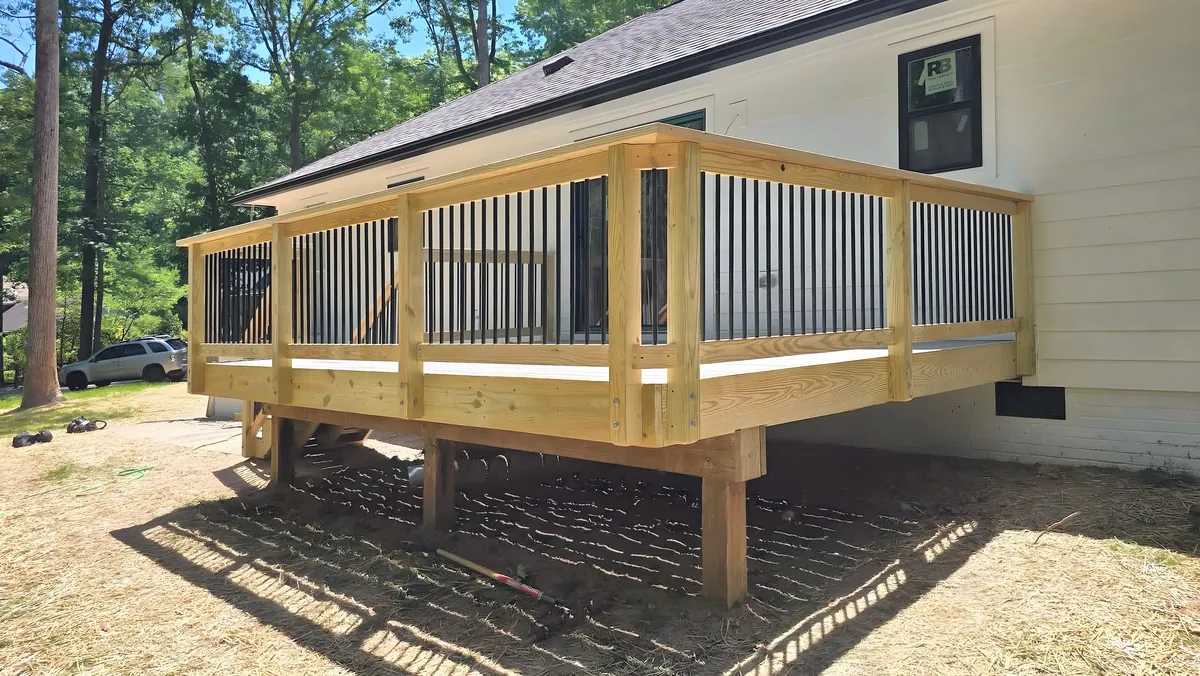
Composite decking doesn't need staining or sealing and won't splinter, which is why a lot of homeowners pick it for new decks and for resurfacing a deck whose framing is still sound.
It still sits on a wood frame, so the framing has to be right and spaced for the boards. We'll lay out the color and railing options side by side and talk about heat, since darker boards get hot in a Carolina summer.
Signs this is the right service
- You want less routine maintenance than wood typically requires
- Your current deck surface splinters or looks worn quickly
- You prefer a more uniform finished appearance
- The deck is used often for entertaining or everyday traffic
- You are replacing an older wood deck and want easier upkeep
How the work goes
Review deck use, sun exposure, and maintenance goals
Select composite boards that fit the desired look and application
Prepare framing and spacing for proper support and ventilation
Install decking with attention to board alignment and transitions
Coordinate stairs and railing details for a finished appearance
What affects the price
- • Composite product line and board style selected
- • Deck size and layout complexity
- • Condition or replacement of existing framing
- • Stair runs, picture framing, or border details
- • Railing material and compatibility with the new deck surface
Every project is priced from a visit and drawings, not from a list. These are the things that move the number.
Questions about composite decking
- Is composite decking worth it for a backyard deck?
- How does composite decking compare to wood maintenance?
- Can composite decking be installed on existing framing?
- Does composite decking work well for stairs and railings too?
- What should homeowners know before switching from wood to composite?
- Ready to Get Started?
We answer these in person. Ask us about your project or call and we'll walk through it.
Related deck building services
Available in Apex, Cary, Holly Springs, Raleigh and nearby neighborhoods.